
by JOHN WATTS with Michael S. Katz
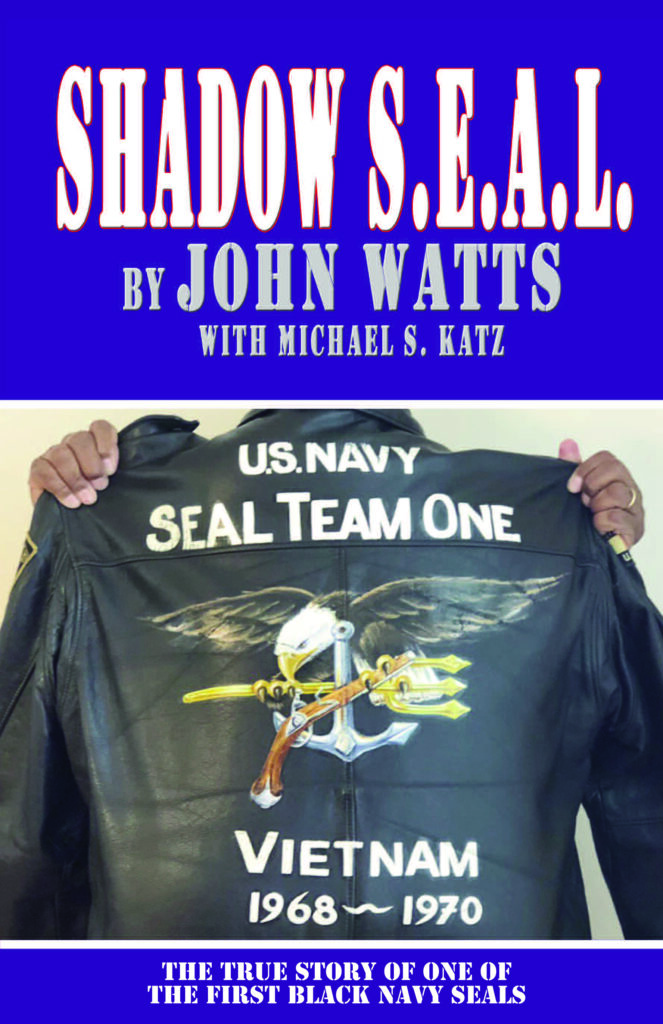
They called John Watts “Shadow” because the Navy had an unwritten rule that using the N-word was not good for morale. John was one of the first Black Navy S.E.A.L.s, and the only Black man in his platoon. As such, he faced more hardship than any of his fellow Naval recruits. Yet he placed his life on the line through two tours in Vietnam despite how he was treated, and despite how his fellow Blacks were treated back in the States.
SHADOW S.E.A.L. is one man’s tale of overcoming constant degradation, of proving himself to those who thought him less than a man, and of ultimately redeeming himself in their eyes.
ON STOLEN VALOR
John Watts, the author of Shadow S.E.A.L., has been accused of stolen valor. There have been persons held out as experts who have stated that according to military records, Mr. Watts was not a SEAL. However, they admit that records show he was in the Navy and did serve in Vietnam. These people apparently did not read the book, wherein Mr. Watts mentioned that many of his official records were destroyed in the 1973 National Personnel Records Center fire, and because of that he later needed governmental assistance to prove he served in Vietnam (so he could receive medical treatment for cancer caused by exposure to Agent Orange). In response to these accusations, Mr. Watts has been trying for years to obtain his records elsewhere to prove his service as a SEAL.
It is a shame that the accusers never gave Mr. Watts any benefit of the doubt or asked themselves, why would he have lied about being a SEAL for, what, fifty years or more? He was already entitled to receive benefits and recognition as a member of the Navy who served in Vietnam, so he never got anything out of lying about being a SEAL, never traded on it, never ran for office, never put himself in the public eye, until he decided to write this book. A book which has caused him more injury than anything he could have gotten out of it. A book which he wrote not to make money, but to tell his story now that he is getting to the end of a life shortened by cancer.
At its crux, stolen valor refers to the act of falsely claiming military service or honors to gain some form of benefit, whether it is social recognition, financial gain, or other advantages. In the 2012 Supreme Court decision U.S. v. Alvarez (567 U.S. 709), six out of nine justices determined that the Stolen Valor Act of 2005 violated the First Amendment because it could apply to any false statement without regard to whether the lie was motivated by financial gain. The Stolen Valor Act was modified in 2013 to make it a crime to fraudulently hold oneself out as a recipient of certain military decorations with the intent to obtain money, property or other tangible benefit.
What is most troubling is that many detractors claim that Mr. Watts is a liar because he says he encountered racism in the service. These people claim that there was absolutely no racism in the Navy. These people who take offense to his assertions of facing prejudice are in turn only demonstrating their own prejudice. If he had never mentioned being a SEAL, would he still have been accused of lying about racism in the 1970s?
Many claims made against Mr. Watts are defamatory, but defamation carries a one-year statute of limitations, and many statements are not discovered until after that time limit has passed. Many defamatory statements get repeated, but those repetitions would not on their own support defamation suits. So Mr. Watts is forced to see his name dragged through the mud. He has explained why he has been unable to verify his claims, while his detractors are not required to disprove his assertions. In a court of law it is the person accused of defamation who has the burden of proving truth as a defense.
I have known John Watts for over 35 years. He has always been a good man in my eyes, and I have always believed him. I can only wait and hope that he is able to prove his detractors wrong.
Michael S. Katz, Esq.